Landfall
$19.99 a month · the client subscribes
The island. 93 tools and 31 challenges, inside a story that runs alongside the work.
One rule runs through all of it: nothing claims more than it can show. No invented numbers, no signature nothing signed, no judgement a machine made quietly on a clinician's licence.
The workspace a therapist runs their whole practice in — the hour, the note, the client's record, the calendar, the money, the video room. It installs on their own computer.
The records stay in their building. No company in the middle holding a practice's clinical history. That is not a setting; it is where the database lives.
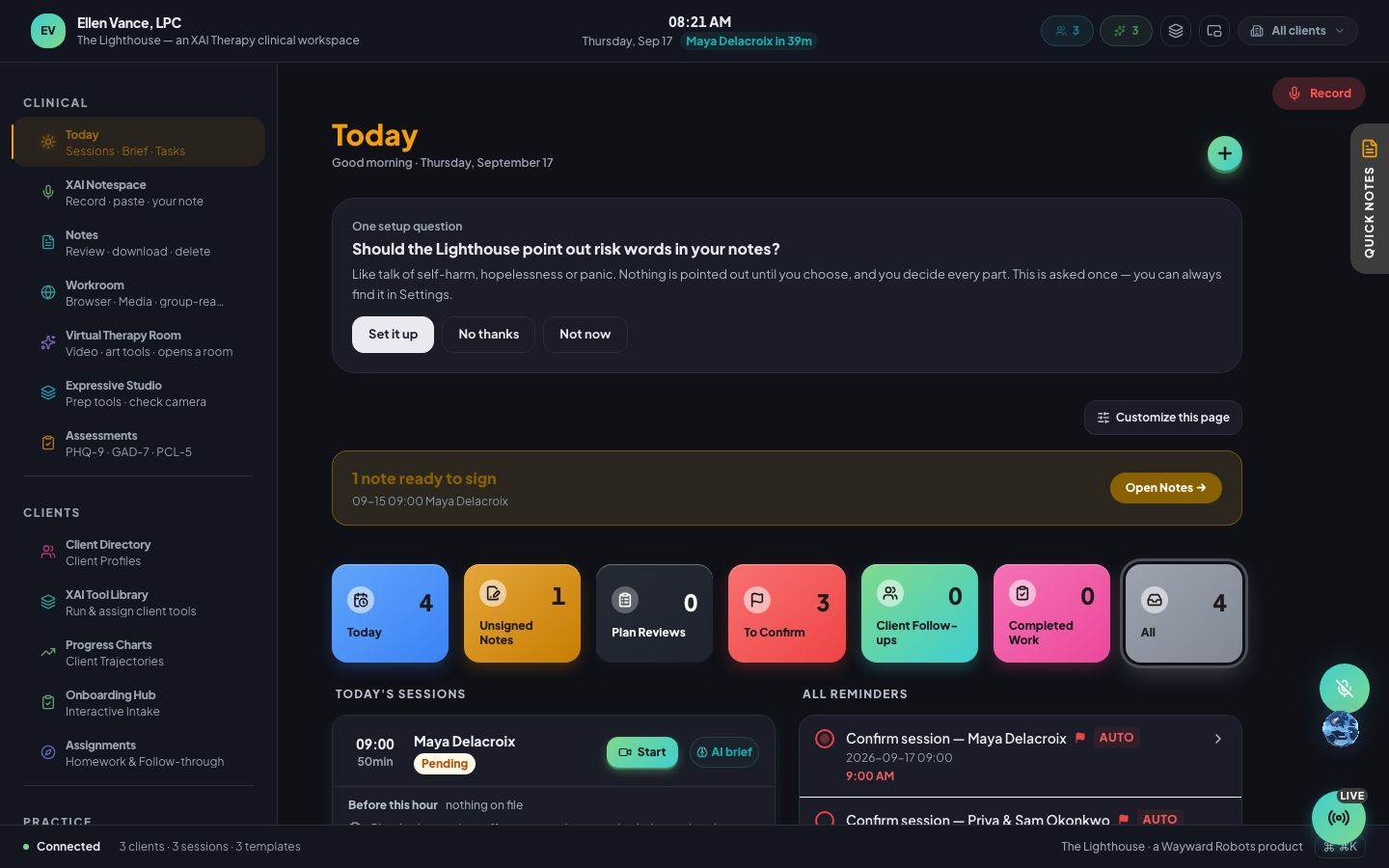
Record the hour and the draft is written on that computer — the audio never opens a socket. What the software will not do is the part that matters most.
Anything drafted in that territory arrives marked UNCONFIRMED — and the note refuses to be signed until you have read it and accepted it. Not a warning you can click past: the signature is refused by the server that holds the record.
The line about risk goes into your notes exactly as you typed it. The software never writes it and never rephrases it.
No signature on file means nothing prints under the note — and the note says so. A document never wears a signature it did not earn.
Signing is what starts the clock — so the one hour you certainly still need the tape for, the one you have not finished, keeps it.
A therapist sends a tool from the Lighthouse. It opens in the client's own app. When they use it, a receipt comes back to the record — and it says what actually happened, or it says nothing.
From their page, or from the hour itself. You choose the tool; nothing is matched to them by a machine.
Landfall, Copperheart or Driftwood — whichever one they are in. The tool is already installed; the message is what is new.
Started, finished, or nothing yet. The record shows the count and never an interpretation of it — "three of the last five" is arithmetic; what it means about a person is the clinician's to say.
The client's own app — theirs, on their phone, bought by them. A therapist does not need a client to have one, and a client does not need a therapist to use one.
$19.99 a month · the client subscribes
The island. 93 tools and 31 challenges, inside a story that runs alongside the work.
$19.99 a month · the client subscribes
The voyage — recovery. 114 tools and 31 challenges.
$19.99 a month · the client subscribes
The shore — couples and families. 119 tools and 31 challenges, built for two people at once.
Counts read from each app's own registries on 2026-09-17, not typed by hand. The worlds in detail →
XAI Therapy is the clinical model the software is built to serve — twenty-five years of practice, written down so that a piece of software could be held to it.
The client is told how the work runs, and what the software does and does not decide, before anything else happens.
The relationship is the intervention. Nothing here replaces it, and nothing pretends to.
What a person does between sessions is data the hour never sees.
Patterns are surfaced as counts, with their source attached, for a clinician to read.
Small, chosen, finishable. The tool is the task; the receipt is the evidence.
What worked in the room has to work on a Tuesday, alone, in a car park.
The client ends holding the skill, not holding an app.
Plenty of software will tell a therapist what it thinks. Very little of it will tell them why, or admit when nothing measured the thing it just said.
Here, where nothing measured it, the screen says so — and saying so is not a lesser product. It is the product.
Black box vs glass box →$49.99 a month · the therapist
The whole workspace, installed on your own computer. Includes 15 client tools you can assign.
$19.99 a month · the client
Bought by the client, for the client. It is theirs, and it keeps working if they stop seeing you.
3 paired clients subscribed and your seat is half price. 5 and it is free. The arithmetic breaks even at two and a half, so a therapist with three clients on a world has already covered themselves.
XAI Therapy was founded by Lance Nabers, LPC — twenty-five years and more than twenty-five thousand clients. The model came first; the software exists because no product on the market would agree to be held to it.
He is a therapist teacher now, and still sees a small private practice — that work, and his licence, live on his own page.